

The Emmancipation Paradox: Women have become unhappier since 1972
 Maureen Down (NY Times) reports stunning data and speculates why the libration of women seems to have made them unhappier while men have become happier.
Women are getting unhappier, I told my friend Carl.
“How can you tell?” he deadpanned. “It’s always been whine-whine-whine.”
Why are we sadder? I persisted.
“Because you care,” he replied with a mock sneer. “You have feelings.” Oh, that.
Hell is Hurting
 Ian Frazier has written a very funny satire in the New Yorker on the impact of global warming for hell and its inhabitants. Enjoy!
THE TEMPERATURE OF HELL: A COLLOQUIUM
According to the best scientific data currently available, both the average and the mean temperatures of Hell have risen 3.8 degrees since 1955. Although an increase of this size may seem insignificant, especially to those not spending eternity there, the reality of the situation is quite different when experienced in concrete terms. For example, occupants of Hell who in 1955 were standing night and day in boiling pitch up to their knees report that, owing to the expansion of pitch at higher temperatures, they now must endure the torment all the way up to mid-thigh, or even higher, during Hell’s warmer seasons. Condemned souls who have to lie on their backs chained to a flat rock while a white-hot sheet of iron is lowered to within inches of their faces have stated that the rise in Hell’s ambient temperature now makes the iron seem much closer to their faces than it actually is.
The Soul Storage Company
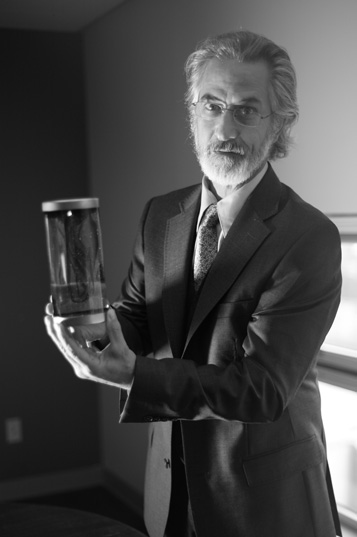 On page 29 of the July 24, 2009, issue of the New Yorker various small ads appear for products like the famous AERON chair, the National Geographic expedition to Costa Rica, organic almond butter, etc. On the top right corner my eyes hit upon an ad for the Soul Storage Company. Its reads:
Is your soul weighing you down?
Store it!
In an outpatient procedure,
Dr. David Feinstein can extract and store your soul
in a state-of-the-art cold storage facility.
Go to the website and see why this ad is probably most ingenious marketing campaign that I have ever seen.
Continue ReadingElectric Car Alert: I want to take the Tesla for a Spin
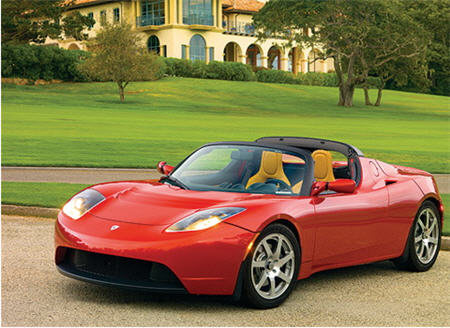 Just read a story in the New Yorker about the development of an all-electric car by the California startup company Tesla. Despite the difficulities of refuelling the car quickly, I would love to experience driving this all electric car. Here is Tad Friend’s report on his test drive:
IT’S ELECTRIC!
This week in the New Yorker, I write about Elon Musk and his company Tesla Motors, which last year began producing the Roadster, the only highway-capable electric car currently on the road. (Subscribers can access the full article.) In April, while I was reporting in Silicon Valley, where the company is based, I spent a few days test-driving the car, an experience both familiar and strange. Once you slide into the Roadster—which, for me, at six feet tall, required some forethought—you’re in a standard sports-car cockpit, one just large enough to fit two people and a loaf of bread. There is no video-game-style joystick or futuristic trackball; the car feels like a car. Only the lack of a glove compartment and the crappy, off-the-shelf JVC stereo-and-navigation system indicate that Tesla was hurrying to get the car out the door.
4.6 million to lie forever on top of Marilyn Monroe
 I don’t know any man who was young in the early 1960s and who did not have a crush on Marilyn Monroe. As this generation is starting to face death, one rich man can be with Marilyn for eternity. The DailyNews reports:
Even in death, Marilyn Monroe is still snagging millionaires.
An unidentified deep-pocketed fan who clearly prefers blonds placed the winning $4.6 million bid Monday in an eBay auction for the crypt directly above the sexy screen icon’s grave. Beverly Hills widow Elsie Poncher put her husband’s strategically positioned crypt on the auction block with a starting price of $500,000. Bidding soared to $4.5 million three days later.
“Here is a once in a lifetime and into eternity opportunity to spend your eternal days directly above Marilyn Monroe,” the eBay auction description boasted. Richard Poncher was buried face down, looking at Marilyn, when he died 23 years ago at age 81, the posting revealed. His 80-year-old widow said she decided to move his remains and sell the valuable vault at the Pierce Brothers Westwood Village Memorial Park cemetery.
Cloud 9 (Wolke 9)
 The idea of making a film about sexual desires of seniors is brilliant. Such a film was overdue. But Andreas Dresen, the 46-year-old director of Cloud 9 constructed a film about his own desires rather than exploring how seniors cope with society’s predilection to see them as sexless creatures. Dresen’s drama is not about the psychological challenges of growing old: losing your partner, falling in love again, wanting physical intimacy with someone who perhaps no longer cares for it. Dresen wants to demonstrate how we can be spooked by breaking many taboos of contemporary sensibilities. Hollywood staffs sex scenes with young women; he opens the film with a long sex scene with a woman in her late sixties and a seventy-six year old man. Even more shockingly, he gives the lead female character Inge (very well-played by Ursula Werner) the psychology of a sixteen-year-old girl who is naive, emotional, reckless, and irrational.
The Philosophical Baby: What Children’s Minds Tell Us about Truth, Love, and the Meaning of Life
 Can’t wait until this book arrives in my mailbox. My own review will come later. In the meantime here is what Anthony Gottlieb wrote in the NYTimes: It’s always gratifying to hear a new twist on an old joke. In the Marx Brothers’ “Duck Soup,” Rufus T. Firefly, played by Groucho, is handed the Freedonia cabinet’s treasury report: “Why, a child of 4 could understand this report. Run out and find me a 4-year-old child—I can’t make head or tail of it.” Alison Gopnik, a professor of psychology at the University of California, Berkeley, has run out and found plenty of 4-year-old children. In her new book, she announces that they are in some ways “smarter, more imaginative, more caring and even more conscious than adults are.” Gopnik does not go so far as to propose that we fire Timothy Geithner and march in a phalanx of preschoolers to fix the credit crunch. She does, however, make the bold suggestion that thinking about small children can shed new light on ancient philosophical problems.
The Times of Harvey Milk
 This documentary about the life of Harvey Milk starts at the moment of his election to the city council of San Francisco. Compared the recent motion picture Milk, the film begins a bit slow but then becomes a wonderful depiction of what made Milk a great politician. It is quite remarkable to see him organize the gay community into a political force. All in all, the documentary is more gratifying than the motion picture because Milk playing Milk is a lot more convincing then Sean Penn playing Milk. Towards the end, the director devotes considerable time trying to figure out what motivated Dan White to shoot the major of San Francisco and Harvey Milk. No good answers emerge from White’s biography. The film cannot uncover any evidence of psychological instability or sublimated aggression that periodically would have erupted. I suspect that if White hadn’t had a gun readily available at home the day of the crime, he would have calmed down
How to Fight ‘Right’ Courtesy of Gretchen Rubin
 Gretchen Rubin shares with you her lessons how to fight ‘right’ and when you click on “More” she also tells how to fight ‘wrong’. Enjoy!
When my husband and I do argue, I find that the single best technique to apply is humor. If one of us can laugh and joke around, the angry mood lifts instantly. But during an argument, my sense of humor is the first thing to go.
Failing that strategy, here are 23 phrases that help turn down the heat of anger:
Please try to understand my point of view.
Wait, can I take that back?
You don’t have to solve this—it helps me just to talk to you.
This is important to me. Please listen.
I overreacted.

© 2026 Peter Murmann. Powered by ExpressionEngine.
